Get In Touch support@charlhe.com Ph: +971 54 576 4134
Case Study 1: HR Dashboard Analysis
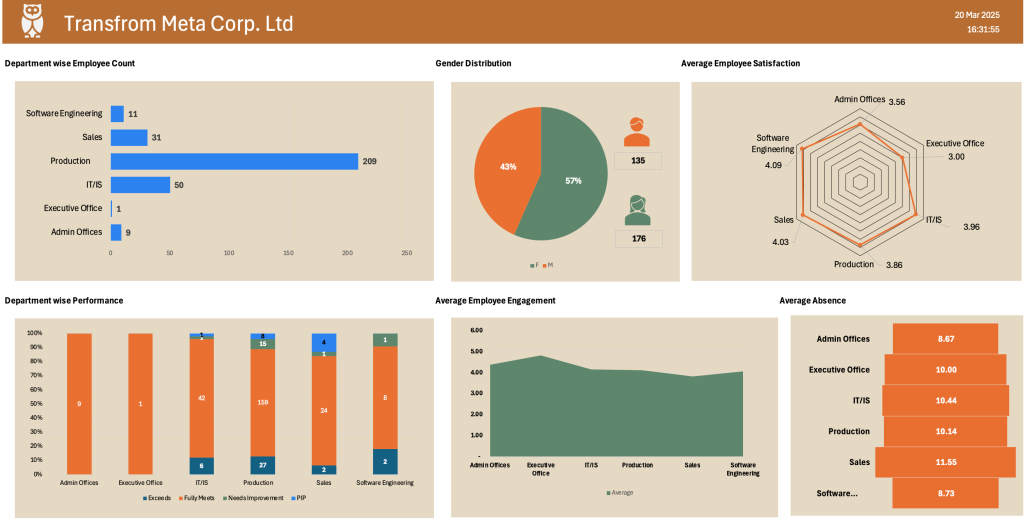
Review the dashboard below from a manufacturing industry. What is your observation from an HR point of view.
1. Production is massively oversized compared to every other department
Production has 209 employees, while the next largest department (IT/IS) has 50. That’s a huge gap.
Why this is a problem
It suggests the company is over‑reliant on one function, which creates operational risk.
Support functions (IT, Admin, Engineering) may be understaffed relative to the load Production generates.
It often leads to burnout in smaller departments because they’re servicing a disproportionately large internal customer.
2. Performance issues are concentrated in Production
Production has:
15 “Needs Improvement”
27 on PIP This is by far the highest number of low performers.
What this signals
Training gaps
Poor management practices
Hiring quality issues
Low morale or unclear expectations
When one department has this many struggling employees, it’s rarely the employees — it’s the system.
3. Sales has the lowest engagement and highest absence
Sales:
Engagement: ~4.0 (lowest)
Absence: 11.55 (highest)
Interpretation
Low engagement + high absence is a classic sign of:
Burnout
Pressure-heavy culture
Compensation dissatisfaction
Poor leadership or unclear targets
Sales is often the revenue engine — if they’re disengaged, the business feels it.
4. Executive Office has the lowest satisfaction
Satisfaction score: 3.0, the lowest of all departments.
Why this matters
When leadership is dissatisfied, it often means:
Strategic misalignment
Internal conflict
Stress from organizational issues
Lack of resources or clarity
If the top is unhappy, the rest of the company usually feels the ripple effects.
5. Satisfaction and engagement don’t align
Some departments have:
High engagement but mediocre satisfaction (IT/IS)
High satisfaction but average engagement (Software Engineering)
This mismatch often means:
People like their work but not the environment
Or they like the environment but don’t feel motivated
It’s a cultural inconsistency worth exploring.
Conclusion
Production’s size + performance problems + mid‑range satisfaction + high absence This combination suggests the company’s core operational engine is strained, poorly supported, or poorly managed.
If I had to name one overarching issue:
The company is structurally unbalanced, with Production carrying the weight but struggling the most.